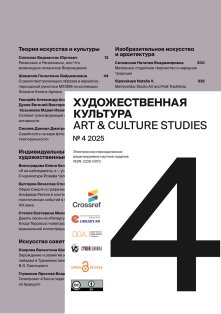
2025 № 4 (55)
Representation of the Ideal Hero’s Environment in Pre-Revolutionary and Soviet Silent Cinema Worldviews
UDC 791.3
BBC 85.374
DOI: 10.51678/2226-0072-2025-4-662-695
For cit.: Evallyo V.D. Representation of the Ideal Hero’s Environment in Pre-Revolutionary and Soviet Silent Cinema Worldviews. Hudozhestvennaya kul’tura [Art & Culture Studies], 2025, no. 4, pp. 662-695. https://doi.org/10.51678/2226-0072-2025-4-662-695 (In Russian)
Evallyo Violetta D.
PhD (in Culture Studies), Senior Researcher, Mass Media Arts Department, State Institute for Art Studies, 5 Kozitsky Lane, Moscow, 125375, Russia
https://orcid.org/0000-0002-4531-4922
ResearcherID: AAS-2640-2020
Scopus Author ID: 58772764100
Representation of the Ideal Hero’s Environment in Pre-Revolutionary and Soviet Silent Cinema Worldviews
Abstract. This article focuses on the spaces of large and provincial cities, interiors, and the specifics of frame construction in the context of the relationship between the human and the material. In our analysis, we examined Ya. Protazanov’s silent films The Tailor from Torzhok (1925), Don Diego and Pelageya (The Case of Pelageya Demina) (1927), The Man from the Restaurant (1927), and The White Eagle (1928). A comparative analysis of these films allowed us to more clearly delineate the director’s specific perception of the pre-revolutionary worldview. The director demonstrates the extreme vulnerability and partial inconsistency of anthropological ideals in the face of any social and political system. Importantly, Protazanov attributes each type of worldview to a particular space and the specifics of its interaction with the characters. Protazanov outlines the external environment quite succinctly, while the most dramatic scenes unfold in interior spaces. The predominantly spatial environment — natural, rural, and urban landscapes — is characterized by extreme staticity.
Exploring the spaces of provincial and capital cities, streets, restaurants, palaces, and cramped rooms, Protazanov considers them unsuitable for human habitation. In his work, the world, cities, and characters are virtually never transformed. The ‘new people’ (communists, revolutionaries) find themselves equally hostage to universal human problems (bureaucracy, the narrow-mindedness and/or cowardice of higher-ranking officials, and the pursuit of personal gain). The spatial environment is characterized by inertia, and the people (characters) find themselves in a specifically demonstrated ‘power vacuum’. The ideal hero possesses a specific set of eternal human values that lie beyond any social or political structure.
Keywords: Ya. Protazanov, anthropological ideal, space, worldview, ‘new man’, city, provincial town, interior, reality
The study was supported by a grant of the Russian Science Foundation (RSF), project no. 24-28-01484 “Anthropological ideals in the adventure films of Russian silent cinema of the 1910s-1920s”.
References:
Bykhovskaya I.M. Sport v otechestvennom khudozhestvennom prochtenii: kul’turologicheskii vzglyad na motivy i narrativy [Sport in Russian Artistic Reading: A Cultural View of Motifs and Narratives]. Hudozhestvennaya kul’tura [Art & Culture Studies], 2024, no. 4, pp. 70–99. https://doi.org/10.51678/2226‐0072‐2024‐4‐70‐99. (In Russian)
Voskresenskaya V.V. Mirostroitel’nye utopii v otechestvennoi khudozhestvennoi kul’ture 1920-kh godov [World-Building Utopias in Russian Artistic Culture of the 1920s]. Hudozhestvennaya kul’tura [Art & Culture Studies], 2015, no. 3–4 (16). Available at: https://artculturestudies.sias.ru/2015-3-4/istoriya-i-sovremennost/4832.html?sphrase_id=407672 (accessed 10.08.2025). (In Russian)
Voskresenskaya V.V. Iskusstvo kak sredstvo mirostroeniya: sotsialisticheskii realizm (1930-e gody) [Art as a Means of Worldbuilding: Socialist Realism (1930s)]. Hudozhestvennaya kul’tura [Art & Ciulture Studies], 2018, no. 1, pp. 166–199. (In Russian)
Deklaratsiya Assotsiatsii khudozhnikov revolyutsionnoi Rossii [Declaration of the Association of Artists of Revolutionary Russia]. Assotsiatsiya khudozhnikov revolyutsionnoi Rossii: Sbornik vospominanij, statei, dokumentov [Association of Artists of Revolutionary Russia: Collection of Memoirs, Articles, Documents], comp. I.M. Gronsky, V.N. Perelman. Moscow, Izobrazitel’noe iskusstvo Publ., 1973, p. 289. (In Russian)
Zyablikov A.V. Formirovanie sovetskoi identichnosti sredstvami otechestvennogo kinematografa v 1920–50-kh gg.: k postanovke problemy [Formation of Soviet Identity by Means of Domestic Cinema in the 1920s–50s: Toward a Problem Statement]. Vestnik Kostromskogo gosudarstvennogo universiteta, 2022, vol. 28, no. 3, pp. 52–62. https//doi.org/10.34216/1998-0817-2022-28-3-52-62. (In Russian)
Kotik N.V. Derevnya v sovetskom kino: ot sotsrealisticheskogo raya do vnesovetskogo prostranstva [The Village in Soviet Cinema: From a Socialist-Realist Paradise to the Out-Soviet Space]. Vestnik VGIK, 2025, vol. 17, no. 3, pp. 33–46. https://doi.org/10.69975/2074-0832-2025-64-3-33-46. (In Russian)
Kochukhova E.S. Gorodskoi obraz zhizni v sovetskom khudozhestvennom kino: k voprosu o metode issledovaniya [Urban Lifestyle in Soviet Feature Cinema: Toward a Research Method]. Idei i idealy, 2022, vol. 14, no. 1, part 2, pp. 392–407. https://doi.org/10.17212/2075-0862-2022-14.1.2-392-407. (In Russian)
Lytkin V.V., Artamonov M.A. Filosofskii ideal i tvorchestvo V.S. Solov’eva [Philosophical Ideal and Creativity of V.S. Solovyov]. Nauchnye vedomosti. Seriya: Filosofiya. Sotsiologiya. Pravo, 2015, no. 20 (217), issue 34, pp. 154–165. (In Russian)
Novoselskaya V.V. Vozmozhnosti kinematografa v preodolenii krizisa kul’turnoi identichnosti [The Potential of Cinematography in Overcoming the Crisis of Cultural Identity]. Vestnik VGIK, 2025, vol. 17, no. 2, pp. 120–133. https://doi.org/10.69975/2074-0832-2025-64-2-120-133. (In Russian)
Rostotskaya M.A. Nravstvennye aspekty russkogo dorevolyutsionnogo kinematografa. Yakov Protazanov [Moral Aspects of Russian Pre-Revolutionary Cinema. Yakov Protazanov]. Vestnik VGIK, 2012, vol. 4, no. 1, pp. 6–15. (In Russian)
Salnikova E.V. “Aelita” Yakova Protazanova: Mars kak chast’ bessoznatel’nogo geroya-intelligenta 1920-kh [Yakov Protazanov’s Aelita: Mars as a Part of the Unconscious of an Intelligent Hero of the 1920s]. Nauka televideniya, 2024, vol. 20, no. 2, pp. 115–150. https://doi.org/10.30628/1994-9529-2024-20.2-115-150. (In Russian)
Sinyavina N.V., Makhovich E.V. Modifikatsiya realisticheskogo ideala v khudozhestvennoi kul’ture Rossii 1860–1930-kh godov [Modification of the Realistic Ideal in the Artistic Culture of Russia in the 1860–1930s]. Vestnik MGUKI, 2018, no. 5 (85), pp. 62–72. (In Russian)
Smagina S.A. “Novaya zhenshchina” kak ideologicheskii kontsept sovetskogo kinematografa 20-kh gg. [“The New Woman” as an Ideological Concept of Soviet Cinema of the 1920s]. Artikul’t [Art & Cult], 2018, no. 4 (32), pp. 174–181. https://doi.org/10.28995/2227-6165-2018-4-174-181. (In Russian)
Soloviev V.V. Sobranie sochinenii Vladimira Sergeevicha Solov’eva. [Collected Works of Vladimir Sergeevich Soloviev]. Vol. V: 1883–1892, eds. S.M. Soloviev, E.L. Radlov. 2nd ed. St. Petersburg, Knigoizdatel’skoe Tovarishchestvo “Prosveshchenie” Publ., 1912. 488 p. (In Russian)
Tulchinsky G.L. Avantyurno-priklyuchencheskoe nemoe kino i sovetskii antropologicheskii proehkt [Adventure Silent Cinema and the Soviet Anthropological Project]. Nauka televideniya, 2024, vol. 20, no. 1, pp. 13–42. https://doi.org/10.30628/1994-9529-2024-20.1-13-42. (In Russian)
Ustinov O.A. Paradigmal’nyi podkhod k analizu antropologicheskikh kontseptsii v russkoi filosofii sovetskogo perioda [A Paradigmatic Approach to the Analysis of Anthropological Concepts in Russian Philosophy of the Soviet Period]. Vestnik MGPU. Seriya “Filosofskie nauki”, 2022, no. 2 (42), pp. 6–19. https://doi.org/10.25688/2078-9238.2022.42.2.01. (In Russian)
Ustyugova E.N. Ideya “tvoryashchei formy” v ehstetike russkogo avangarda 1920-kh godov [The Idea of “Creative Form” in the Aesthetics of the Russian Avant-garde of the 1920s]. Hudozhestvennaya kul’tura [Art & Culture Studies], 2024, no. 1, pp. 12–33. https://doi.org/10.51678/2226-0072-2024-1-12-33. (In Russian)
Khrenov N.A. Kinematograf ehpokhi revolyutsionnoi smuty: real’noe i virtual’noe [Cinematography of the Era of Revolutionary Troubles: Real and Virtual]. Hudozhestvennaya kul’tura [Art & Culture Studies], 2017, no. 4 (22). Available at: https://artculturestudies.sias.ru/2017-4-22/sotsialnaya-filosofiya-i-sotsiologiya/5274.html?sphrase_... (accessed 10.08.2025). (In Russian)
Shmidt I.M. Russkaya skul’ptura vtoroi poloviny XIX — nachala XX veka [Russian Sculpture of the Second Half of the 19th — Early 20th Centuries]. Moscow, Iskusstvo Publ., 1989. 304 p. (In Russian)
Evallyo V.D. Statika i dinamika prostranstvennykh form v priklyuchencheskikh dorevolyutsionnykh fil’makh P. Chardynina i L. Kuleshova [Statics and Dynamics of Spatial Forms in the Pre-revolutionary Adventure Films of P. Chardynin and L. Kuleshov]. Yaroslavskii pedagogicheskii vestnik, 2024, no. 6 (141), pp. 302–311. http://dx.doi.org/10.20323/1813-145X-2024-6-141-302. (In Russian)
Banerjee A. The Atom, the Alien, and Cosmographies of the Anthropocene. Russian Literature, 2020, vol. 114–115, pp. 127–150, https://doi.org/10.1016/j.ruslit.2020.07.007.
Gillespie D. The Art of Literary Adaptation and English-Language Film Interpretations of Russian Literature (“Anna Karenina”). Procedia — Social and Behavioral Sciences, 2014, vol. 154, pp. 30–35. https://doi.org/10.1016/j.sbspro.2014.10.107.
Received 11.08.2025
Accepted 22.09.2025